Giving Time for Creative Flow

I started playing piano at age five, but stopped taking lessons around age 12 when I got busy with other activities. But when I was plagued with the stresses of high school, I picked it back up on my own.  I played the piano regularly, sightreading familiar songs, tuning out the world around me, forgetting about homework and friend drama, and completely losing track of time. I claimed it was my own form of therapy, and research shows it was.  Though I didn’t know it yet, I was experiencing a flow state.

Flow is a state of consciousness of absolute absorption in an activity.  Experts say regular experiences of flow state are incredibly beneficial. People who regularly experience a flow state of consciousness are less susceptible to depression, experience growth and a sense of purpose in life.  Mihaly Csikszentmihalyi coined the term Flow in his research in 1970. Almost any activity can lead to a flow state: creating art, music, swimming, playing chess, studying, even video games; they tend to have some or all of these components:

1. It’s a challenging activity that requires skills
2. Ability to concentrate
3. Clear goals
4. Immediate feedback
5. Free from worry
6. Control or Choice
7. Loss of Self-consciousness
8. Participant loses track of time

After a back injury ended her career, former dancer Julia Christensen searched for other ways to experience flow state she regularly encountered while practicing and performing. She discovered that drawing dancers gave her a similar state of consciousness. She became a neuroscientist, and her research shows the benefits of flow state on one’s mental health. She advises finding activities that trigger flow state and suggests rituals to create a sense of control and reinforce a mindset that leads to flow more often.  It’s a skill that’s truly transformative.

As a school administrator, my goal is to help students enter a flow state during learning activities both for enjoyment and so that they can work at the edge of their potential.  There are several factors to make a learning activity flow-friendly. It should be challenging enough to stimulate their high achieving brains but not so challenging that it doesn’t feel doable.  It should honor a student’s need for autonomy and provide some choice within the parameters of the learning outcome, which should be clearly communicated to the student. The environment should feel safe and comfortable so the child doesn’t feel self-conscious, worried or distracted. And there’s time for encouragement and celebration from a teacher and peers. 

At Chronos Academy, classwork is challenging enough so no one finds it boring, but scalable so they’re approachable. Students have some choice everyday like which math topic to tackle, what topic to research for their weekly presentation, and which learning challenge to master. Tutorial hour and Free-build is built into the daily schedule to promote long periods of uninterrupted creativity. Of course there are factors beyond a teacher’s control, and every child is different, but when the whole class enters a state of creative flow, it’s wonderful!

For people of all ages and all intellectual abilities, establishing a lifestyle of regular bouts of Creative Flow is ideal!  Parents certainly benefit from uninterrupted productivity daily; besides a break from care-taking, it gives them a sense of purpose and a feeling of accomplishment. As a new mom, I considered teaching a break because someone else was caring for my little ones.  And I regularly found myself engrossed in long projects like sewing super hero capes for a birthday party, organizing the hall closet, or crocheting Christmas gifts for extended family!  My husband often took over the bedtime routine, so I could complete my marathon task to my satisfaction.
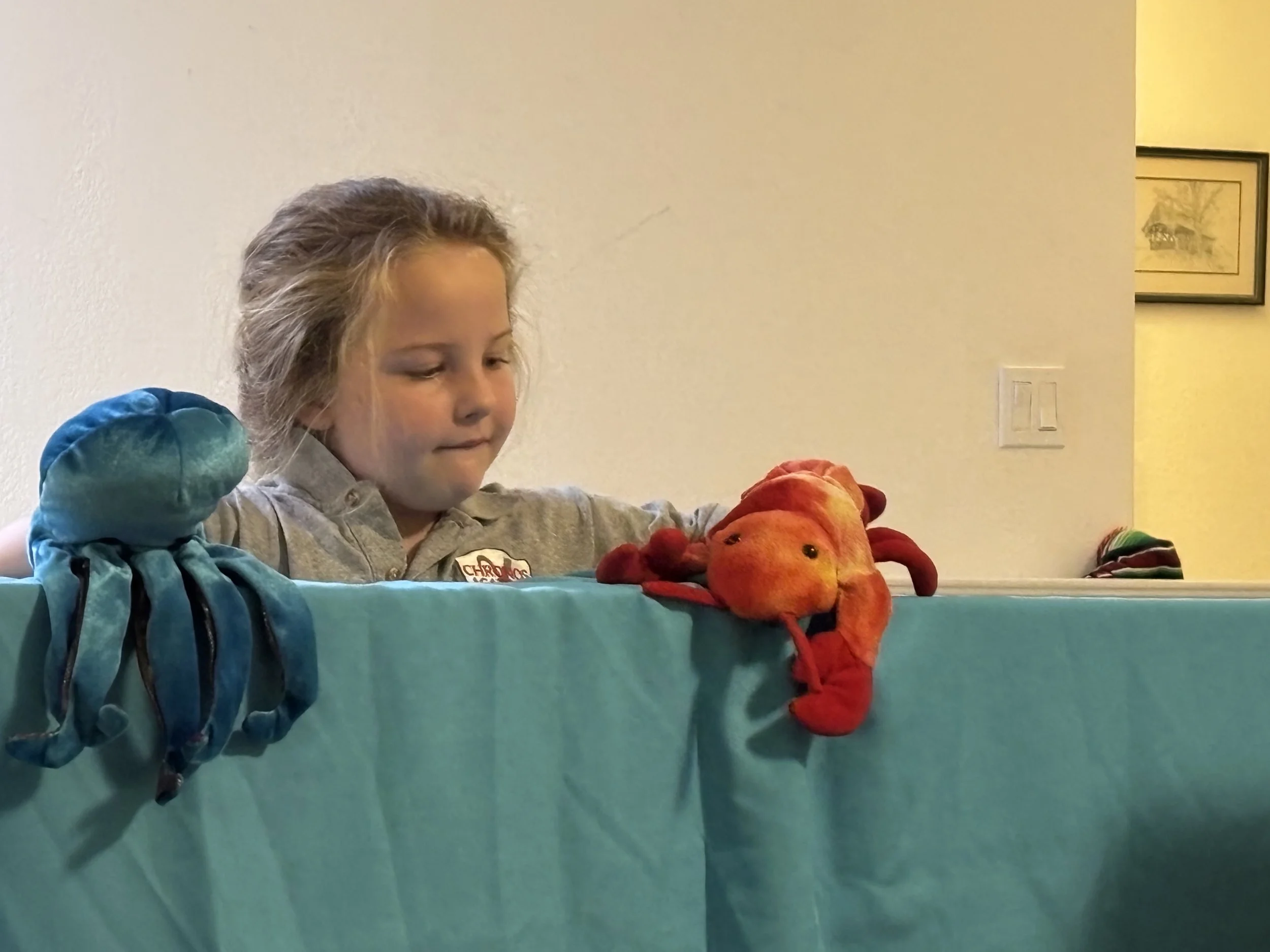
We parents can also build Flow into our children’s routines.  The easiest way for children to enter a state of Flow is child-directed play. In the right circumstances, children become engrossed for hours in a pretend world they’ve created alone or with peers.  My children make stuffed animal zoos, sea creature puppet shows, stop motion videos, GarageBand songs and Minecraft worlds. Sometimes I bait them with a challenge, and often they come up with their own ideas. 

In child-directed play, parents often take a backseat. It’s imperative that parents are relaxed and allow time and space for independent play. Parents stop what they’re doing and play along and enjoy it. The Australian TV series Bluey is a case study in this child-directed play and a healthy balance of parent involvement. We’ve learned a lot from the Heeler family, and we’ve incorporated “Keepy Uppy,” “Toilet Tag,” “Shadowlands” and “Dance Mode” into our family game repertoire.

According to Mihaly Csikszentmihalyi, Flow in the family context has five characteristics:

•Clarity: children know what parents expect from them;
•Centering: children know that their parents are interested in what they are doing in the present;
•Choice: children feel that they have a variety of possibilities from which to choose;
•Commitment: trust that allows the child to feel comfortable enough to set aside the shield of defenses and become unself-consciously involved; and
•Challenge: providing increasingly complex opportunities for action.

One of the greatest responsibilities we have as parents is empowering our children to create, perform, learn and play in a Flow State. So chill out, relax, stay home, do your own project and give your child time to flow and grow!

Growing up with a Growth Mindset

My 8-year-old daughter is the only one in the family with curly hair. She gets a lot of compliments, which invariably make her skin crawl, and she recently told me she didn’t want to cut it because people would notice and say something to her that would be embarrassing. She seems to feel shame when people note her appearance, but when people compliment her singing after a choir performance, she not only accepts it but also brags that she had to stand for hours! She's prouder of her accomplishments than traits she inherited.

As a mom and a 3rd grade teacher, I want to do my best to instill a growth mindset in the children in my care, so I’ve been thinking a lot about Carol Dwek’s Mindset: The New Psychology of Success. The kernel of her advice: praise children for effort rather than abilities.  Instead of saying, “You figured that out; you’re so smart,” say something like “You worked hard to understand that.”

A fixed mindset focuses on achievement, winning the game or getting the answer correct, and people who hold a fixed mindset believe that their abilities are fixed, perhaps even predetermined at birth. They often take a defensive posture, protecting a self image made fragile by the prospect of failure.

Children with a fixed mindset shy away from challenges when they fear they won’t succeed.  For PE one day, I taught the students my limited repertoire of jump rope tricks including criss-crossing. Most students tried it, a few succeeded, but one gave up almost immediately: “I don’t jump rope.”  No matter how much I encouraged, he would not practice anymore. Fixed mindset exhibit A.

A growth mindset does not worry about outcomes and takes on a challenge just for pleasure. Another child challenged himself to jump to a new record count, which he broke over and over again for weeks! People with a growth mindset give up outcomes, not sure if they’ll succeed or not, but are willing to try. A feeling of defensiveness would be out of place since the ability isn’t there yet – ability awaits effort.They stretch their capabilities to the demand of the problem. Rather than ask, “Can I do it?” they ask, “What would it take?” They work at the edge of their intellect and abilities, frequently enlisting experts to help and attain whatever skills are required to do the task.

In her recent revisit in EdWeek, Carol Dweck emphasizes that people are more likely a mixture of both growth and fixed mindsets. The key to growing a growth mindset is to identify our personal triggers. Feeling inadequate, criticized or jealous may lead to fixed thinking. We must capture these fixed mindset thoughts and change them to growth. Carol Dweck suggests we try adding “yet” to redeem negative thoughts. “I’m not good at climbing … yet.”  “I don’t like broccoli … yet.”

Open Challenges

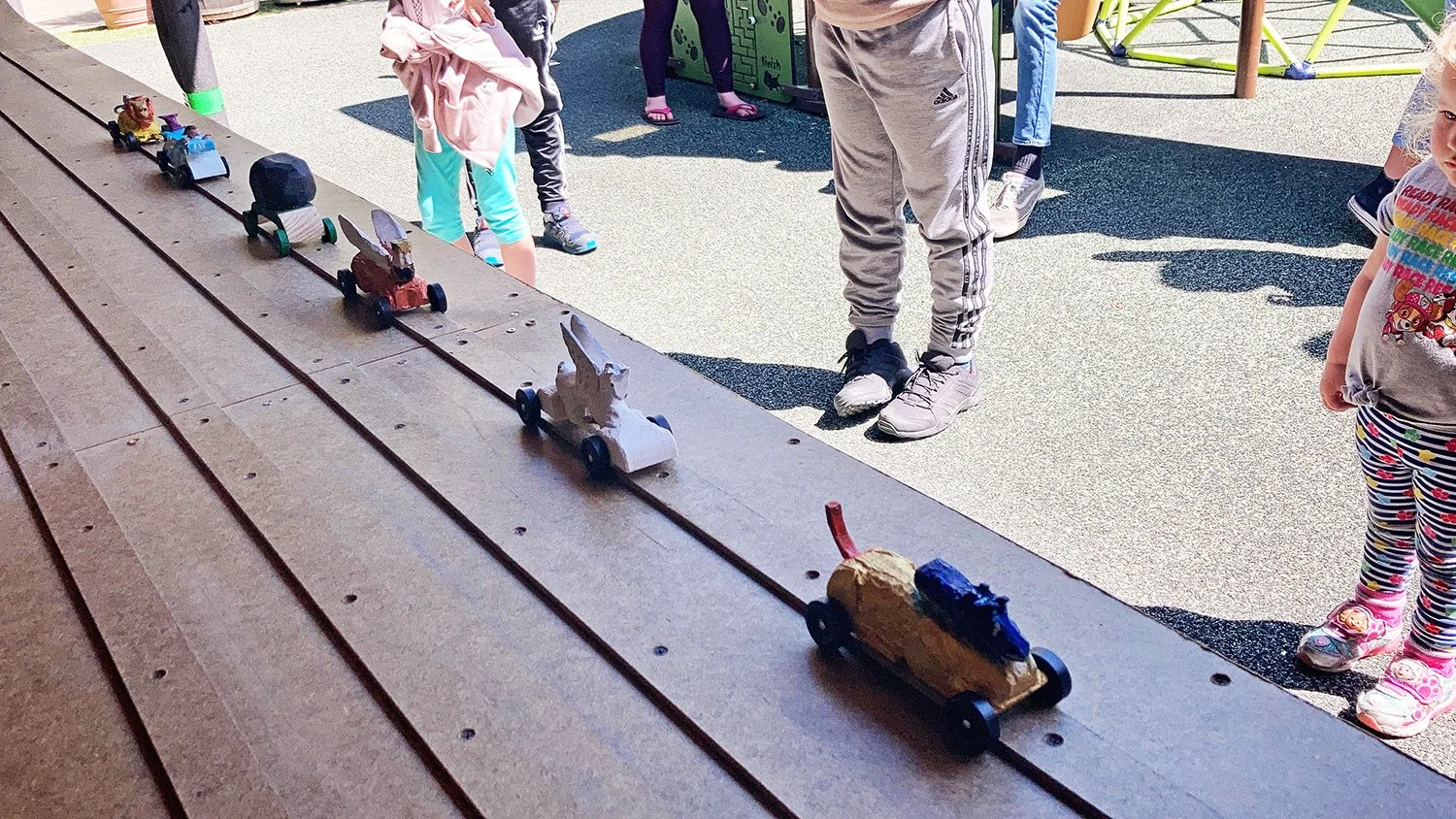
At our school, challenges are open to many possible solutions. This year K-8th graders designed marble mazes with a variety of obstacles, boxes of any shape that lock and pine wood cars inspired by mythical creatures. Odyssey of the Mind teams work together to plan and execute creative solutions to problems with no outside assistance from teachers or parents and present their creations or skits at regional tournaments. 

Preschoolers can benefit from the same types of challenges. With a variety of recyclables on hand, challenge a preschooler to build a robot or a hide out. Ask him to re-enact a story with costumes or puppets. Ask her to make something to sell and create a sign to attract customers.

Quality Feedback

Our students thrive on encouragement and collaboration. They give presentations weekly and students offer questions and ideas for further research. They bounce ideas off each other to create collaborative inventions in the workshop. Teachers challenge students to earn awards for playing the recorder, completing their Greek or mastering the history content.

Watch quality feedback transform your child’s mindset. Acknowledge your child’s initial idea, motivation to try it, stamina to work for a long time, finishing a hard step, testing, troubleshooting and perhaps succeeding or failing, but learning from the process!  Celebrate failures as much as successes because we often learn more from failure!

Modeling

The best way to instill a growth mindset in your kids is to practice a growth mindset yourself. Be open with them and share your process. Let them hear you transform your thinking, challenge yourself, and maybe they will give you some encouraging feedback. Following your example, they will grow a growth mindset alongside you. You and your children will take advantage of more opportunities and enjoy learning together!

Here are some books for you and your children to get you growing together!

Mindset: The New Psychology of Success

Fail-a-bration

The Boy Who Makes A Million Mistakes

The Girl Who Makes A Million Mistakes

Growth Mindset Workbook for Kids
I Can Do Hard Things: Mindful Affirmations for Kids

The Power of Yet: A Picture Book

Brightwheel blog

Originally published in The Crier, Southern Marin Mothers’ Club, June 3, 2025

The World Needs Gifted Girls

Growing up, I loved math. To me, it was a game with a complex rule set that I could win! I just knew the answers, often faster than everyone else, and found myself competing with several boys for the top score each test. I worked hard for my A in that class, but it wasn’t fulfilling and it even felt selfish. As I planned my schedule for senior year, I opted to use my extra electives for psychology and sociology instead of math. My teacher called me out of another class to challenge my decision. Naively, I insisted, “I don’t want to pursue a career in math; I want to help people.” I never took another math class.

Our seven-year-old daughter amazes us every day. In kindergarten, we started her on first grade Beast Academy, an online math program for accelerated learners; she couldn't get enough. She’s picked up piano and now violin twice as fast as her older siblings. Daily she wows us with deep scientific questions and incredible insights of how the world works! She’s proud of her accomplishments and unhindered by the opinions of others.

Her sister, almost exactly ten years older, is now a junior in high school. Both girls have tested at a gifted level, but today they present their abilities very differently. Ten years ago, she was just as driven, confident & unhindered, but our high schooler is much more committed to helping friends than completing schoolwork, and she just doesn’t have the same academic drive that she used to. Instead she studies people. She psychoanalyzes her classmates and counsels friends in need with empathy and wisdom beyond her years. She’s clearly using her intellect in a new way, but she no longer sees herself as gifted. So what changed?

One likely factor is self-evaluation. The confidence of all girls plunges 30% between the ages of 8 and 14, much more dramatically than boys and with a much slower recovery. Studies show that tween girls often grow more unwilling to take risks, more reluctant to speak up in class, or hesitant to try something new.

Gifted girls…have abilities urging them forward, prompting them to explore all that education has to offer, yet education does not run to meet them

Gifted girls have an even harder time. In her article for the Davidson Institute, Dr. Joan Smutney digs in, “Gifted girls…have abilities urging them forward, prompting them to explore all that education has to offer, yet education does not run to meet them.”

Girls' competitiveness often yields to empathetic collaboration so they may even avoid success because they don’t want to differentiate themselves. Girls, in general, prioritize relationships and often change their behavior to fit in. “The Horner Effect” describes a fear of success causing girls to purposely hold back because of a more acute need to please others. I was incredibly unpopular among girls in school; perhaps it was because I was willing to put my energy and enjoyment into math?

Similarly, girls are notoriously eager to please teachers, so if they finish their work early, they likely wait patiently, whereas gifted boys struggle with misbehavior when they get bored. As a result teachers often underestimate the abilities of gifted girls, heuristically training their attention on children who might make learning a problem for the rest of the class. 

Societal gender biases work against gifted girls as well. Parents often reinforce humility and politeness in girls but assertiveness and competition in boys. They are more likely to explain away their abilities due to luck or an error on the part of the evaluator. This “Imposter Phenomenon” pressures girls to explain away their success since it contradicts their self-image and social expectations.  The TV series Bones features Dr. Temperance Brennan (“Bones”) who often claims her expertise by candidly stating her status among others in her field. When her supervisor offers that she is “the leading forensic anthropologist in the nation,” Bones corrects, “in the world,” and the other characters cringe. Socially impaired, she lacks the programming that states it is unacceptable for a woman to take credit for abilities or even accomplishments.

Researching this article has forced me to face my own biases, missed opportunities and “selfless” priorities. A decade after I swore off math in high school to “help people”, I found myself drawn to teaching over and over again. And the biggest need?  Math. I’ve eaten my words for 20 years since, as I’ve taught math at our school and tutored math in the evenings, helping dozens of girls gain confidence in this male-dominated field. Why couldn’t I realize that doing what I was gifted in could actually help people? How far could I have gone in math? And how much more could I be giving!

So, join me in empowering girls to develop the skills they’re good at, instead of denying themselves to fit in or help others. We’re not going to make girls more competitive or less polite, but maybe we can show gifted girls how developing their gifts can benefit others. Giftedness is not only a gift received but a gift to give. If they spend their school years developing it as much as possible, when they share it, gifted girls will inevitably make the world a better place!

Let’s continue the conversation about gifted girls & boys. Learn how to choose the right school for your gifted child and to advocate for his or her intellectual and social needs this Thursday May 23 at our Zoom panel discussion: Education to Nurture Your Gifted Child. 

Consider joining or supporting a local organization that empowers girls!

Girls Scouts
Marin Girls Chorus
Girls Who Code
Recreation Center Sports
Single Gender Schools

Originally published in Southern Marin Mothers Club The Crier.

When School Is Too Easy

Most of my few memories of first grade were getting in trouble for not staying on task: I sharpened my pencil repeatedly, then because it was too sharp I scribbled on a paper towel. I made a little pool of glue on scrap paper and arranged crayon shavings (from my crayon sharpener) in the pool to create modern art. I even got my name on the board for talking out of turn. I was off to a rough start. That same year I was given an IQ test and qualified for the gifted program (LEAP) one half day per week in the library. However, I was not allowed to participate until my “work habits” improved.  They did, somewhat.

In fourth grade I started the ACTION gifted program once a week.  A dozen of us were bussed to a special classroom where we learned to type on a manual typewriter, transliterate our own haikus into Japanese characters and write books and illustrate them on DOS computers. High tech for the 80s.

Daniel remembers swearing off homework, resigned to stop wasting his time and learn for himself.  He enjoyed class but spent evenings reading the encyclopedia.  He got in trouble for talking and interrupting the teacher, but often he won them over with his impressive intellect.  Daniel got poor grades through high school but managed to be accepted into the university where his mom taught as a professor. He passed by the skin of his teeth with an English degree and then became a teacher.

We survived school fine. But we developed some bad habits along the way. I remember proudly putting homework off and completing it in another class while ignoring the lecture. I crammed for tests for a few minutes as the teacher was taking roll, and I hardly read any assigned books, but skimmed cliff’s notes instead.  And when I received As & Bs, it reinforced a divergent ambition to fake it with as little effort as possible.  Not the kind of person I’d like to hire!

I had bumped up against an academic glass ceiling. The common name for this obstacle is “age appropriate” or “grade level standards”. We measure all kinds of things against time: income, the trajectory of a projectile, the quality of a fine wine, the speed a child grows up (invariably, too fast!). Some of these always provide accurate predictions. It is possible to determine the exact force and angle of a bat to baseball to clear the Green Monster at Fenway Park. It is not possible, however, to predict how tall a random child will be at age 12. Nor can anyone say whether a child will be a strong reader by fourth grade. The range of reading capabilities is broad, but the average is a tiny, precise value easy to create “grade level” material for. Because of the average value’s minute exactitude, it actually describes no student at all!

It certainly didn’t describe me! I don’t quite know why, but reading exhausts me. It’s likely the strabismus of my left eye, rendering it blind to central vision (but otherwise fully capable). Did I fail to enjoy science and history because they were, at heart, reading classes? What if the skills of storytelling and scientific experiment had been liberated from the words on the page, presented on their own for me to experiment and discuss independent of my reading endurance? I can barely imagine what other worlds of opportunity remain sealed away as I grew to consider certain subjects boring, hard, or unrewarding.

Carol Dweck has identified a deep solution for gifted children who have become lazy, accustomed to learning being easy for them. These children, when faced with a big challenge that isn’t solved quickly, have an identity crisis. They fake disinterest, make an excuse, they cower from the opportunity. They exhibit a fixed mindset, “They believe that they're born with certain intelligence, skills and abilities that cannot change.” Her solution: growth mindset, in which “people believe that their most basic abilities can be developed through dedication and hard work—brains and talent are just the starting point.”

Fixed mindsets exist, however, because they work. They work in environments designed to teach and manage average children — of whom, again, there are precisely zero. Gifted children are outliers in their classroom, they have to make their own way. They can’t fit the assumptions their classroom was designed around, and as they grow, they build a model of how the world works. For them, classwork is always easy. The hard part is what to do with all those pesky extra minutes after completing the work, or with all those amazing questions that don’t fit the curriculum’s parameters. It can be demoralizing rather than invigorating to excel academically.

We’ve been thinking a lot about this for years. We have a student who got in trouble at previous schools for interrupting class because he knew all the answers but lacked the self-regulation skills to give other students a turn. We have another student who refuses to admit when he doesn’t know something. Both of these boys felt anxious when it took them more than a few minutes to complete an assignment. But they’re growing. They have to! They’re breaking down a fixed mindset that says it should always be easy for them. They are developing intellectual stamina for the first time. They are learning how to give effort even when they feel anxious or tired. Now that's the kind of person I’d like to hire!

Todd Rose, a researcher in developmental psychology, proposes that the classroom needs to be customizable to each student like a driver seat can be adjusted to nearly any size person. He proposes no more “grade level” expectations, rather teaching concepts and skills assuming some skills, such as reading, are not necessarily fully developed. He says to design the curriculum all the way to the edges of children’s skills, from undeveloped to fully mature.

If school is too easy for your child, here’s how to help them build intellectual stamina: give your child challenges well beyond their capabilities and see how far they can go. Cultivate relationships with grandparents, family members and friends who are experts in a field and who will gently share their knowledge with your child. Look for a school or program that encourages children to learn at their own pace, especially in Math, Language Immersion, Reading and Writing. Hire a tutor to work with your child individually on topics and skills that he or she is interested in. Whatever resources you have at hand, give your child the rich content, varied experiences, open challenges & quality feedback they need to thrive.

My father-in-law’s aphorism fits, “If you shoot for the moon, you’ll likely hit the light pole. But if you shoot for the light pole, you’ll hit your foot.”